
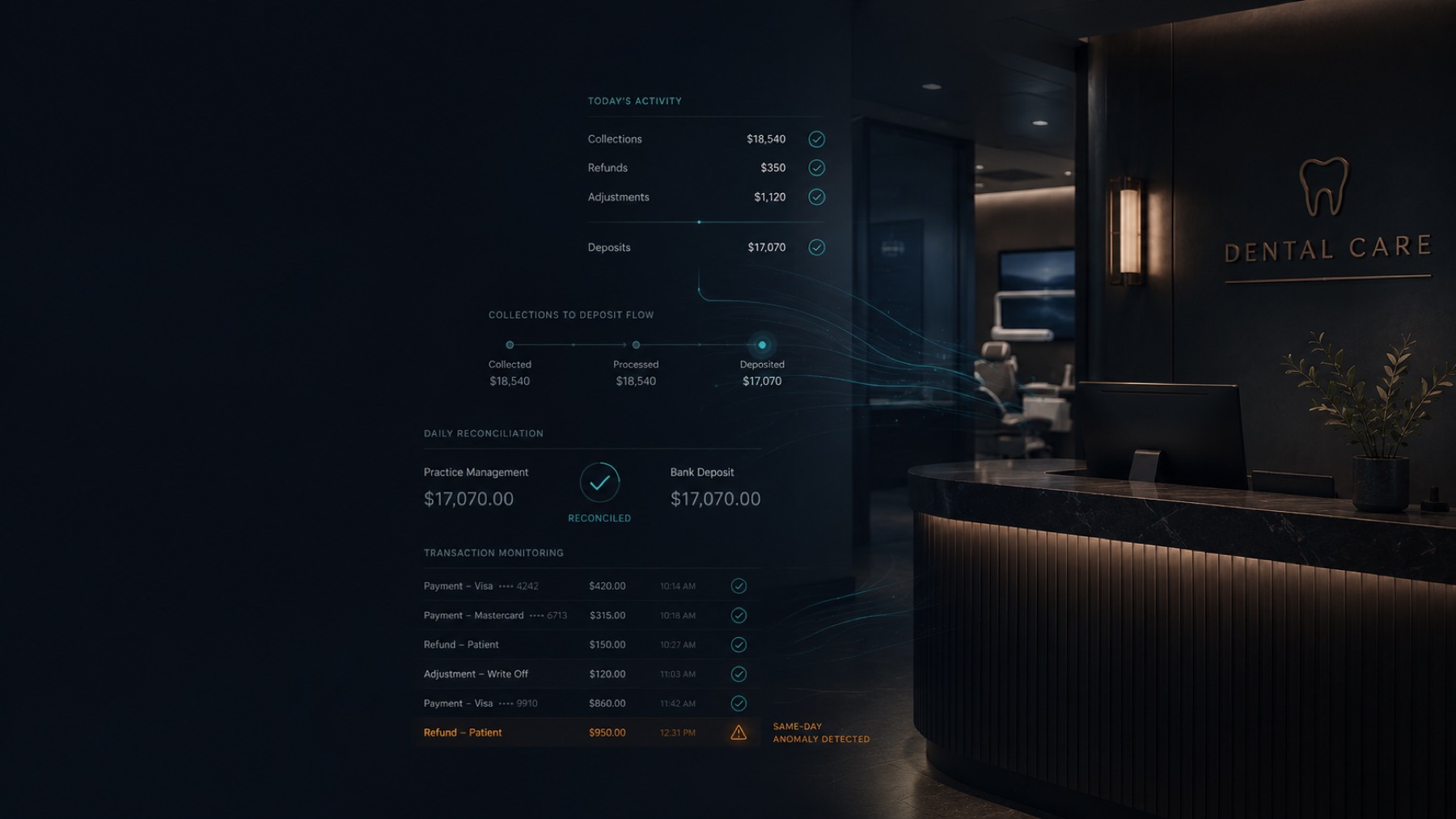

More than half of dental practices have money stolen: 35% once, and 17% more than once (ADA survey). That number is high enough that it is worth asking why. Not just how it happens, but why it happens to dental practices at this rate in particular.
Dentists are not worse judges of character than other business owners. The dental practice business model concentrates several conditions that make embezzlement easier, all at once, in a way that is specific to how these practices are run.
A small staff handling a large amount of money
Most independent dental practices run lean. A small team moves a large amount of money, and that combination does not leave much room for the kind of separation of duties that limits opportunity in a larger organization. In a three-person front office, one person often handles scheduling, billing, insurance claims, and the bank deposit, not because that is the ideal setup, but because there is no one else to hand any of it to.
Revenue that runs through more than one system
Dental income does not move in one straight line the way a retail sale does. It comes in through patient payments, insurance reimbursements, write-offs, and adjustments, often weeks apart and reconciled by hand. Every one of those points, an adjustment entered incorrectly, a reimbursement redirected, a write-off applied to a balance that was never actually uncollectible, is a place where a small, repeated deduction can sit unnoticed for a long time. A cash register either balances or it does not. A dental ledger with dozens of moving categories is much harder to eyeball, which is exactly why deliberate manipulation tends to go undetected for so long once it starts.
An owner who is not trained to watch for it
Dentists go to school to become clinicians, not administrators. The demands of the chair mean most owners spend the bulk of their week treating patients, not reviewing books. That is not a criticism. It is the job. But it means the person with the most at stake financially is often the person with the least time and the least background to catch a problem early. The financial side of the practice gets delegated, almost by necessity, to whoever is capable and willing to take it on. Over time, that person accumulates more access and less oversight, not because anyone decided that was wise, but because nobody else had the bandwidth to check in.
A small team, a fragmented revenue flow, and an owner without the time to watch either. The structure produces the conditions, regardless of how honest the people are.
Put those three conditions together and the result is a business model that consistently produces the conditions embezzlement needs. Dental staff are no less trustworthy than staff anywhere else. The structure around them simply offers fewer natural checks.
By the time it surfaces, the typical loss is already $109,000, and close to two years have usually passed since it started (Prosperident). That is not a reflection of how careless any one owner was. It is what happens when a structural gap goes unwatched for that long, in a business built in a way that makes the gap easy to miss.